
By Rabbanit Shlomit Piamenta
About four and a half years ago, on a Beit Hillel journey, we sat in a gallery exhibiting Haredi art and heard about processes of change within Haredi society.
Four years ago, at the "Listening and Taking Action" conference, we spoke about the need to reach out to those parts of the Haredi community that were undergoing change.
About three years ago, in a turbulent and polarized period, we set up a dialogue group bringing together Beit Hillel rabbis and rabbaniyot and Haredi men and women, to talk and maintain personal connections.
About two years ago, during the war, we began building what would eventually be called "No'adu": a shared journey for religious and Haredi men and women, exploring issues facing Israeli society.
The journey toward the journey included raising funds, making formative decisions about its structure and content, extensive consultation, finding suitable participants, and more.
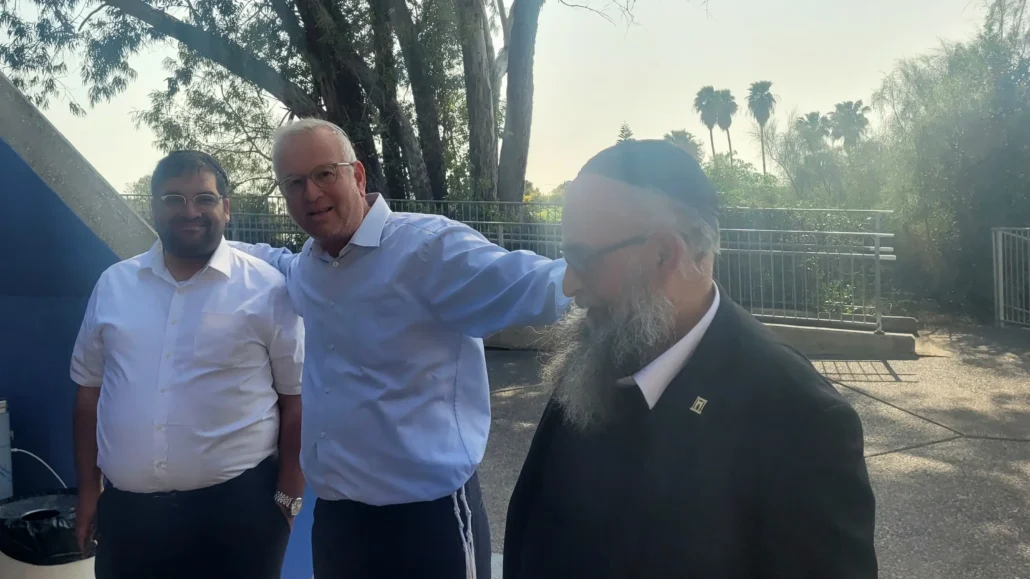
This week, the first No'adu journey took place. Just two days, but what two days they were! Two days of intense, vulnerable, painful and uplifting encounters with brothers and sisters from different parts of the Haredi community.
On the surface, our journey took us through Neve Tzedek, where we encountered some of the roots of questions of identity that still resonate in Israeli life today, and were moved by synagogues that had been saved from demolition. We continued to south Tel Aviv, where our friend Rabbi Asher Meshulam hosted us at his synagogue, and we heard a range of voices from within and beyond the group. The following day we visited the Gaza border communities and toured the Yad Mordechai Museum, which brings to life Polish Jewry between the world wars and the Warsaw Ghetto Uprising. We reached Ramla for a meeting with Mino Abu-Laban, whom some may remember from our Beit Hillel journey, to discuss multiculturalism and the responsibilities of leadership.
Beneath the surface, the journey moved between heartwarming encounters with wonderful people and deep disagreements and fierce anger. The conversations were frank and emotions ran high; at the same time, there was a precious sense of responsibility and connection. When we were smiling and at ease, we wanted to reach the deeper currents and confront our disagreements. When we did, we sometimes felt they were overwhelming us and almost breaking our little boat apart. We looked for the fine line between pain and anger, for our shared desire to strengthen our people and Torah in our different ways, and for mutual recognition that each of us seeks to fulfill our calling as a leader with faith and love.
In the end, we did find it.
And we found friends who share our commitment to deep thought, to facing difficult questions, and to profound, enriching mutual listening.
We called the journey "No'adu," after the verse, "Can two walk together unless they have agreed to meet?" Its underlying understanding is that we are all here to stay. We are walking together along the difficult, surprising path of our times. We share a commitment to carrying Torah forward in this generation, and perhaps we are meant to walk together. Nearby verses ask, among other things, whether a shofar can sound in a city without its people trembling, and whether a bird can fall into a trap when there is no snare. Throughout the journey, I felt that we all hear the shofar in the city and tremble, and from that place seek a way to "join oneself with the community," as Abaye teaches concerning the traveler's prayer. And we all pray that the bird of our soul, our Torah and faith, will not fall into the many snares around it, but will spread its wings and soar.
From Participants' Feedback
"Despite the difficulty, I am full of gratitude for the encounter that took place. I did leave feeling that the distance between our thinking and its basic assumptions is vast and very far from being bridged, but I believe in this path. I understand that this dialogue could not have avoided passing through the painful points, but I would very much like to move forward from them. If only we could study Torah together. Talk about serving God. Try to find not only the gap, but also points of understanding."
"Alongside being a good journey, it was an unbearably heavy one. In a round of sharing that took two days and was interrupted hundreds of times by painful, angry responses, we were asked: What is the pain you bring? … I cried. I am crying again as I write these lines and remember … There was an experience here of deep, empathetic, caring listening, and of real help, clarification and explanation."
"This week we came together and traveled on a moving and enriching journey organized by Beit Hillel's rabbis, a precious organization that brings Torah closer to the people and promotes fruitful dialogue between different parts of the Jewish people. There I had the privilege of getting to know wonderful rabbis and rabbaniyot who share a vision of building bridges and fewer walls, an approach that enables genuine, responsible dialogue even in the face of deep disagreements … I learned to understand the other side in depth, sharpened my own views, and felt a natural closeness to the Religious Zionist community, and, to my regret, a greater distance from the extreme groups on the Haredi side. All this was thanks to Rabbi Meir and Rabbanit Shlomit, who led this journey with professional, sensitive and inspiring guidance. They created a safe and enlightening space that changed perspectives and left a deep mark on the heart. Huge thanks for such an initiative. I hope to take part in more like it!"
"I felt, as an individual and as a rabbi, that I was given a hearing that strengthens a hurting, aching heart, and tools that will help bring better communication and understanding in the future. The challenges are not over … Clarifying our differences emphasized the interdependence and mutual responsibility between the communities, the bridges between our worlds, and why those very bridges cause pain and disappointment when the burden of defending the nation is not shared. Family stories were shared: a brother killed, a nephew killed, men of immense Torah learning, wisdom and heart. Truly, at last, as brothers, all our hearts wept together."
"Despite the difficulty and the turmoil, this was a fellowship, and this was a deeply meaningful walk together. For that, I want to thank you from the bottom of my heart. Thank you to everyone involved for the honesty, the personal stories and the insights that will stay with me for a long time."
"The journey shook me between hope that communication is possible and frustration; between brotherhood and alienation. I heard words emerging from the depths of the heart and saw them touch other hearts, and other words that emerged from the depths and were brushed aside with a joke. There were important moments of unguarded connection, some of them difficult, and there were also missed opportunities. Above all, I was glad to face the challenges of opening my heart to what is unfamiliar to me."
"I came away from this encounter with many insights. One is just how great the distance is. I imagined, or hoped, that our shared commitment to a world of Torah was a stable, strong bridge connecting us. I discovered that the bridge does exist, but it spans a very, very great distance. Another insight is that this great distance is rooted in real pain. … And despite all the difficulties, I want to say that this attempt is of the utmost importance … I therefore think that continuing is essential. We have begun to build a bridge between us. Not as 'representatives' of a community, but as individuals who can lead efforts to build and strengthen bridges and relationships, to create genuine connections."