Session no. 1 of Meshu'ot – the joint beit midrash of Beit Hillel and Dror Israel. We will deal with the connection between Chanukah and education, out of an understanding that education is the foundation of every society and recalls Chanukah in spreading a gentle light that grows and grows.
Yonatan Huber: Chanukah in my eyes is one of the peaks of Judaism. Precisely because we do not light the whole chanukiah at once; precisely because of the small chanukiot on the windowsill; because of this thing that is lit anew every day, and not lights hanging lit for a whole month and week of dazzle. Every day we light candles anew, and sing anew, and bless anew, and that reminds us in the darkest days of the year that it is upon us. It is upon us to light the light. Each and every one, again and again, night after night, a small light. For that is what we are – only a small light. But it is important, to drive away the darkness, even with a small light. Even though the light is destined to burn out. Even though it is not upon us to finish the work. Even if only within the family, or with friends. Even alone. Even when no one sees. And yes – every day one more light, because the effort pays off, the work pays off, slowly. And it cannot be done with a bang, not all at once. There is no "wow" in the work of repair. There is no "bang" in driving out the darkness. Only a Sisyphean lighting of small lights in the darkness. One by one. Again and again. Judaism is not a religion of grandiose fantasies, not of splendid temples, not of dreams of a salvation bought in a single hour. It is a religion of true hope, realist, sober. Our festival of lights is not a festival of giant trees surrounded by dazzling lights, jingling decorations, huge piles of gifts, and a family that gathers once and that's it. Bang and we're done. Our festival of lights is not a lazy morning with children opening gifts and a whole week of vacation. No, no. Our festival of lights is a festival of small lights, solitary, on a window. A festival of families and friends who gather, evening after evening, to drive out the darkness together. A festival of waiting for guests, of moving from lighting to lighting, from house to house. To spread the light, each day somewhere else. And in the morning to get up as every day for work. To continue the work.
Opening conversation: Share an experience of education that you remember (an experience that educated you) and an experience of yours as educators. What is Chanukah for you? How do you customarily mark it?
The learning begins from the first place in Jewish literature that spells out the information and law of Chanukah: Tractate Shabbat in the Talmud. There is no tractate on Chanukah, for it is a relatively young festival without much halakhic volume, and the Talmud discusses it incidentally to the discussion of lighting Shabbat candles (it is interesting to compare the candles). The basic laws of Chanukah are brought from the words of the Tannaim – the sages of Israel who lived in the first to third centuries, between the end of the Second Temple period and the time of the Bar Kokhba revolt.
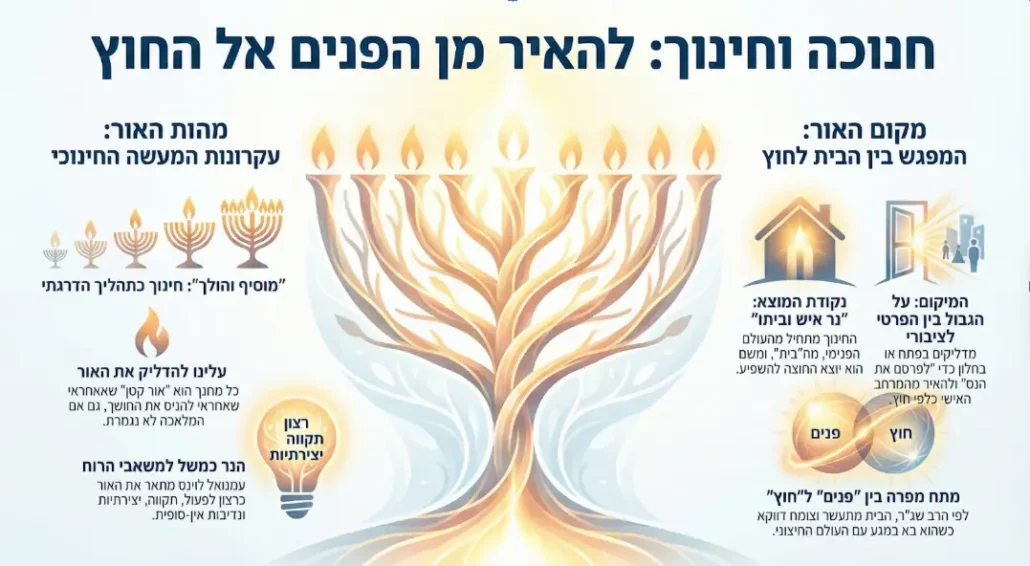
Tractate Shabbat 21a-23b: "Our Rabbis taught [the Sages said]: 'The commandment of Chanukah is a candle for a man and his household; and the mehadrin (those who beautify), a candle for each and every one; and the mehadrin of the mehadrin – Beit Shammai say: on the first day one lights eight, and from then on decreases; and Beit Hillel say: on the first day one lights one, and from then on increases.' [Rashi's commentary: a candle for a man and his household – one candle each night, and a man and all his household members suffice with one candle.] … Our Rabbis taught: 'A Chanukah candle – it is a commandment to place it at the entrance of one's house, on the outside. If he lived in an upper story [second floor] – he places it in the window adjacent to the public domain. And in a time of danger – he places it on his table, and that suffices.' [Rashi: on the outside – because of publicizing the miracle.] … Rava said: a Chanukah candle – it is a commandment to place it within a handbreadth of the entrance. And where does he place it? Rav Acha son of Rava said: on the right; Rav Shmuel of Difti said: on the left. And the halakha is: on the left, so that the Chanukah candle will be on the left and the mezuzah on the right."
How many candles must be lit according to the baraita? And what is the hidur (beautification)? And what is the hidur of the hidur? Where should the candle be lit, and why? If the idea is publicizing the miracle, why not light specifically in public places? Why must one light close to the house or in the house?
The principle of the importance of the home on Chanukah arises from the words of the halakhic authorities, for example:
Rambam, Laws of Chanukah, ch. 4, halakhot 1-2: "How many candles does one light on Chanukah? Its commandment is that each and every house lights one candle…"
Biur Halakha on Shulchan Arukh, Orach Chaim 675: "And the main obligation rests on the house."
How do you understand the statement that the obligation of the Chanukah candle "rests on the house"? Why specifically on the house?
The practical meaning of the connection between lighting the candle and the house is subject to a dispute among the halakhic authorities, which we will not have time to enter here in its details. If we return to the connection between Chanukah and education: what is the symbolic meaning of lighting the candle at the meeting point between the home and the outside, in your view? Think about the concepts of "home" and "outside" that accompany you in your work. From which layers of "home" do you act? Toward which "outside" do you aim your influence?
Interim summary: We have seen that the halakha says to light a Chanukah candle for every house, and there are additions defined as "mehadrin" and "mehadrin min hamehadrin" (the customs of the mehadrin were accepted and today are considered the norm). We have also seen that the place of lighting is on the border between the house and the outside – on the window or at the doorway. The lighting of the candle is meant "to publicize the miracle," but it is not done in public spaces; rather, precisely on the boundary of the private space, facing outward. In general, Chanukah is connected to education – as educators we act from our private place, from our personal resources, outward. One cannot educate without involving the self, the personality, and the inner world. Education demands shining from the private outward.
Sefat Emet, Chanukah 1894:
"The commandment of Chanukah is a candle for a man and his household. And it is difficult: what is different from all the commandments, and what is the matter of the commandment being for the house?… Why should not every obligated person light by himself? And it can be said that when all the powers of a person and his household members who belong to him are gathered, he can fulfill the commandments more completely. And the commandment of the Chanukah candle is outside – that a person should be able, through his deeds, to bring light into the place of darkness. And for this a person must take with him all that depends on him. And the blessed God created man in this world so that he could bring the light of Torah into every physical act, when he does it according to the Torah as fitting. And therefore it is not right to seclude oneself; rather, the will should be to bring everything close to the blessed God. And the children of Israel are praised for accepting the exile willingly, in order to draw light also in the darkness, to fulfill the will of the blessed God. And so in the exile of Egypt, when Jacob and his sons went down, it is written 'a man and his household came' – that they prepared themselves with self-sacrifice and all that was theirs to His will, blessed be He. And so too the Chanukah candle outside, as above – a man and his household. And the mehadrin, a candle for each one, is a higher level – to repair each and every detail of those dependent on him. And for us – would that we merit to repair in general."
How does the Sefat Emet expound the expression "a candle for a man and his household"? What is the house and what is the outside in his words? What is the darkness and what is the light? Do you identify?
Rabbi Yehuda Aryeh Leib Alter (1847-1905) was a Rebbe in the dynasty of the Ger Hasidic rebbes and one of the most prominent leaders of Polish Jewry at the end of the 19th century. Under his leadership, Ger Hasidism became the central Hasidism in Poland. He is known by the name of his book series "Sefat Emet," which contains novellae he wrote on the Torah, on the festivals of Israel, and on the Babylonian Talmud. He compares the gathering of the family members beside the window for the lighting of the Chanukah candles to the gathering of the powers of the soul for the sake of influencing outward. In this he sees the fulfillment of the mission for which man was created – to influence through his physical deeds when they are done as fitting. Further, he compares the lighting of the candle in the time of darkness to Jewish existence in exile – the people of Israel was called into exile in order to light up the world with good deeds, and for that one must gather all our inner powers.
From the story "The Menorah" / Benjamin Ze'ev Herzl:
"At first one candle is lit, then another and another, and still others. The darkness will pass entirely. Among the young, the children of the poor, the light will break through first, and afterward the others will follow them – the lovers of justice and truth, of freedom and progress, of humanity and beauty. And when the candles are all lit – they will marvel and rejoice at the work that was done. And there is no more important and happiness-bringing role than the role of the shamash, the servant of the light."
Who are the educators and who are the educated, according to Herzl? Herzl relates to the role of the shamash. When did you fill the role of a shamash? What are your feelings toward this role?
2. From "To the Volunteers Among the People," Chaim Nachman Bialik:
Reveal the light! Expose the light!
If mountains of dusk are heaped upon us –
not all the sparks have gone out, not all are gone;
from the mountains of the dusk we shall yet hew a flame,
from the clefts of the rocks – sapphires by the myriad.
Upon the soil of the people and in the depths of its soul –
its Shekhinah shall yet gleam and sparkle.
O, come together for the great work!
Let us roll away the mountains of dusk, roll them away!
Let us expose the layers of the many lights!
O, sons of the Maccabees! Raise up your people, establish the generation!
Reveal light, reveal light!
Bialik does not relate to the lighting of light but to the revealing of light. What do you think of his interpretation? Where in the work of education have you encountered a role of revealing light?
Emmanuel Levinas, Difficult Freedom (p. 307):
"Chanukah is… the wonder in the candle, the wonder of the 'much' that is found in the 'little'… the blazing love…, the wonderful will to act… the hope that rises toward its light… the patience that bears what could kill it. This is about the infinite resources of the spirit that rises above, as one that creates, as one that originates, beyond the wisdom of the deed of techniques; without calculations, without a past, it pours itself, joyful, into the space, commits itself to the affairs of the other gratuitously and showers generosity upon him."
Levinas describes the Chanukah candle as the resources of the spirit. What is the character of the spirit he describes here? When did you feel that you act and influence in this way?
Emmanuel Levinas (1906-1995) was a French-Jewish philosopher and educator. Here he compares the candle to the human spirit, which is characterized by activism, creativity, spontaneity, and effortless multiplication. If we continue the comparison between the light of the candle and the act of education, one can see in this passage a description of a personality that educates by the force of its presence and being, when the encounter with the world is done without effort and without inhibitions, and the good in the educator influences his surroundings.
Rabbi Shagar, "To Illuminate the Doorways":
"Can a researcher, a son of Western culture, understand a distant and foreign culture of a remote tribe, living in an existential space completely different from the researcher's culture? (…) To understand a culture he must be part of it. And here there is a real contradiction between his standing as a researcher, which requires a reflective gaze, and the inner understanding of the tribesman. Perhaps this is what Chanukah comes to teach us. On the one hand, the elevation of the inner point; the cruse of oil sealed with the seal of the High Priest; the covenant; the point of belonging and homeliness. Hence the need to preserve the homeliness – 'a candle for a man and his household.' Therefore buying a Shabbat candle, intended for the peace of the home, precedes buying a Chanukah candle, which is the illumination outward; therefore in a time of danger one places the candle on his table, and that suffices. On the other hand, the house becomes poor when it does not come into contact with the outside, and therefore we bring the candle out to the doorway of the house. This is the root of the great fertilizations that the Jewish religious world was fertilized by external influences…"
When in your work do you feel tension and contradiction between the inside and the outside, or between your domestic space and the external space in which you act? When do you find that this tension fertilizes and grows? Compare the words of Levinas and the words of Rabbi Shagar. What is the difference in their conception of what happens on Chanukah? With which point of view do you identify more?
Rabbi Shimon Gershon Rosenberg (known as Rabbi Shagar; 1949-2007) was a rosh yeshiva and a modern religious thinker, creator of a thought in which there are neo-Hasidic and postmodern characteristics. Here Rabbi Shagar deals with the tension between inside and outside embodied in the lighting of the candle on the boundary of the house. The Chanukah candle belongs to the house and also to the outside, and symbolizes the point of tension and fertilization between them.
Finally, it is worth watching the video of returned hostages celebrating Chanukah. The war shook the boundaries of our private and collective homes and made evident the great darkness that exists around us and within us. Before us is the challenge of adding light and succeeding in influencing the dark places. It is joyful to listen to the words of the hostages, which are full of light, and to find connections between them and what we have learned.