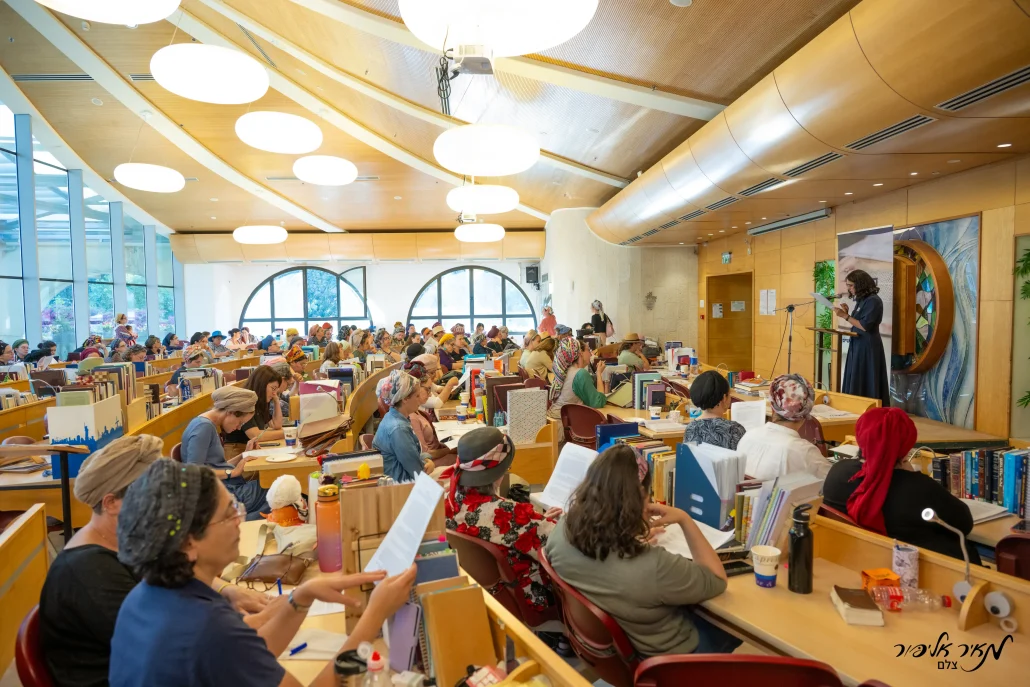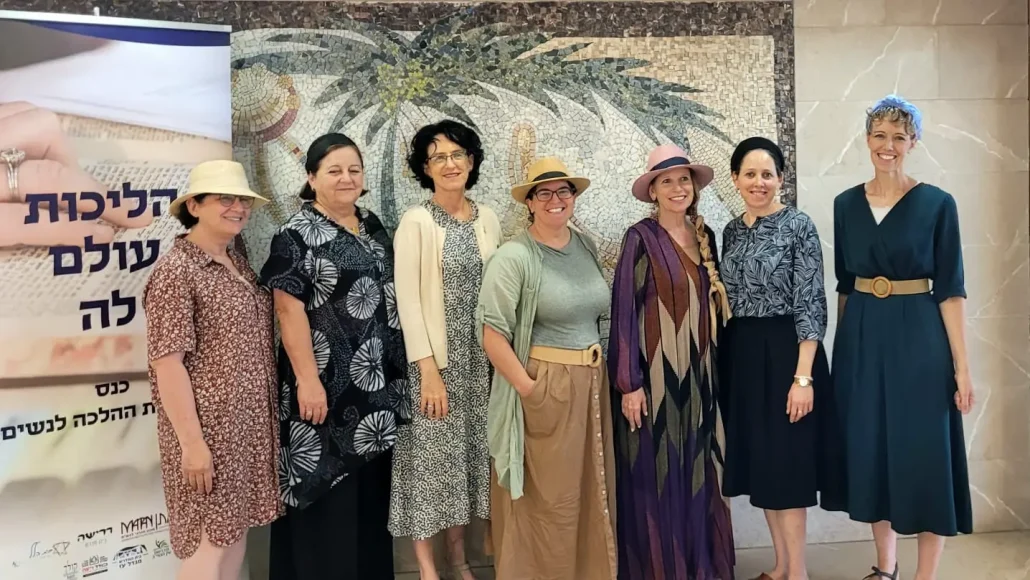
Halichot Olam Lah – these are words that say it all. Halakha walks (holekhet). That is why it is called halakha. It advances and grows with reality. Halakha does not stop, and does not run either – like the messengers who walk slowly. And we, the women of halakha – we too. We are here as if it had always been so. We are already part of the ways of the world (halichot olam).
*
So what did we have at the first Halichot Olam Lah conference?
There was an elevation of spirit reserved for rare events. A marvelous gathering of the outstanding women of halakha in the country, from different programs and different places, who joined together in impressive cooperation.
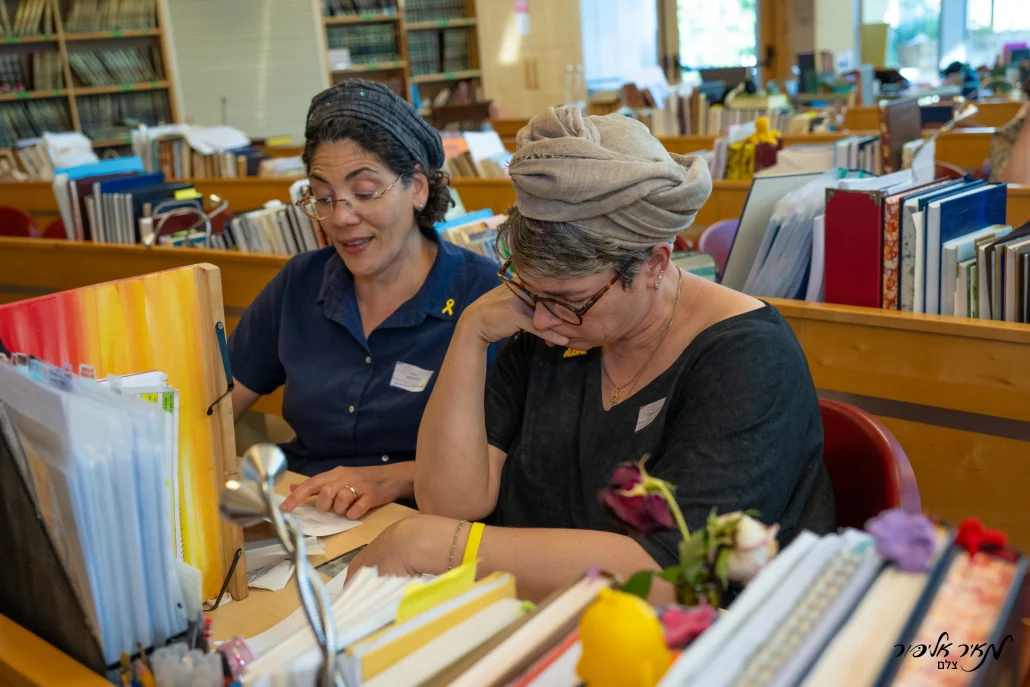
There was study, in a class by Beit Hillel member Rabbanit Prof. Tova Ganzel with study partners, and there were very short lectures, some of them by Beit Hillel members:
Rabbanit Noa Lau surveyed the state of the world of Torah study for women across four decades.
Rabbanit Ariella Bigman described the important role of rabbaniyot in the periphery.
Rabbanit Shira Marili Mirvis shared the questions that reach her as a community rabbanit.
Rabbanit Yael Shimoni called upon women of Torah to act more in the world of education for all ages.
Rabbanit Ayelet Segal presented the importance of the role of a school rabbanit.
In addition, discussion tables were held on various subjects, and there too Beit Hillel members stood out:
Rabbanit Rachel Reinfeld-Wachtfogel, director of Meshivat Nefesh, spoke about the world of spiritual accompaniment and the importance of its tools for rabbis and rabbaniyot.
Rabbaniyot Esti Rosenberg and Michal Tikochinsky discussed the question of how to raise women Torah scholars (talmidot chakhamim),
Rabbaniyot Chana Godinger-Dreyfus and Yael Shimoni dealt with dilemmas in the world of women's learning,
Rabbanit Hila Naor spoke about the new world of military rabbinate for women,
and Rabbanit Batya Krauss dealt with connecting rabbaniyot to diverse populations.
The entire evening was led by heads of programs and institutions, among whom Beit Hillel members also stood out – such as Rabbanit Chamutal Shoval, head of Kolech Da'ah; Rabbanit Ashira Koren, head of Matan HaSharon; Rabbanit Racheli Fraenkel, head of the Beit Midrash at Matan Jerusalem; Rabbanit Chana Godinger-Dreyfus, head of Yeshivat Drisha; and Rabbanit Esti Rosenberg, head of the Beit Midrash at Migdal Oz.
Alongside the general excitement of this pioneering evening, it was especially powerful to see the centrality of Beit Hillel in the women's Torah world. Women of Torah need and seek a home – a place of belonging that is not only feminine but connects rabbis and rabbaniyot to a shared and fruitful Torah discourse. Thus the women's Torah world can grow organically into the broad contemporary beit midrash, receive and give treasures of spirit and wisdom, and join the female voice to the great generational choir of the people of Israel. Happy are we that we merited it.