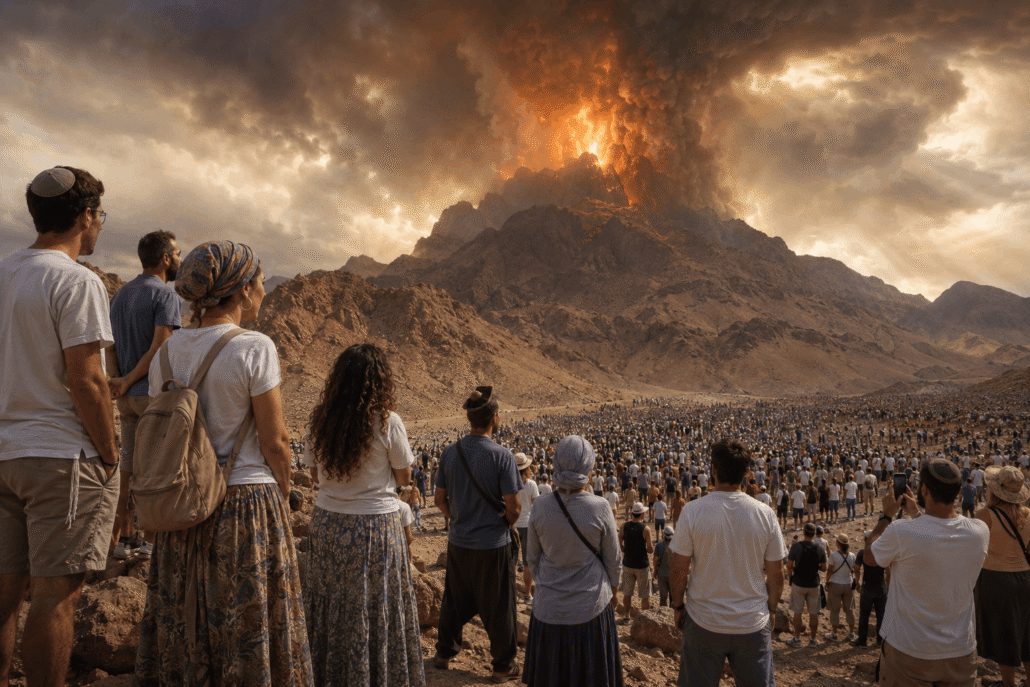
Session no. 5 of Meshu'ot – the joint beit midrash of Beit Hillel and Dror Israel. We will deal with the festival of Shavuot as "the day of the giving of the Torah." What is the source for identifying the festival with the giving of the Torah? What is the character of the festival's founding event, and why? The way the tradition tells about the giving of the Torah highlights significant components that shape our different identities.
A. On the source of the name "the festival of the giving of the Torah"
In the Torah, the festival of Shavuot is not connected to the giving of the Torah and is quite empty of content (except for the prohibition of doing work and the commandment to offer a sacrifice like the other festivals). The event of the giving of the Torah is described at length, but without noting the exact date.
Exodus 19: "In the third month after the children of Israel went out of the land of Egypt, on this day they came to the wilderness of Sinai. And they journeyed from Rephidim and came to the wilderness of Sinai and encamped in the wilderness; and Israel encamped there, opposite the mountain."
The description includes the month – the third, that is, Sivan – but not the day of the month. The location is also vague. The Midrash Seder Olam Rabbah from the Tannaitic period (1st century CE) adds details:
Seder Olam Rabbah, ch. 5: They journeyed from Rephidim to come to the wilderness of Sinai and found clouds of glory upon it. All five days Moses would go up to the top of the mountain and come down and tell the people the words of the Omnipresent, and return their words before the Omnipresent. On the third day, on the sixth of the month, the Ten Commandments were given to them – and it was the Sabbath day.
The tradition according to which the giving of the Torah took place on the sixth day of the month of Sivan was accepted in the people of Israel. The festival of Shavuot too, which in the Torah appears without a date and whose time depends on the counting of the Omer, was fixed with the fixing of the calendar to this day – and thus the festival of Shavuot became the festival of the giving of the Torah.
B. One heart opposite the mountain
The verse describes the arrival of the people of Israel at Mount Sinai in the words "and Israel encamped (vayichan) there opposite the mountain" – that is, in the singular.
Rashi on Exodus 19: "And Israel encamped there" – as one person with one heart; but all the other encampments were in complaint and in dispute.
Tanna Devei Eliyahu, Chapters of Descents (Ish Shalom), ch. 3: Rabbi Eliezer says: from the day Israel left Egypt they were traveling and encamping in dispute. What is said? "And they journeyed and they encamped and they came." When they came to Mount Sinai, they all encamped opposite the mountain, with one heart and with one counsel.
Why was it important in your eyes to note the standing of receiving the Torah as part of the festival of Shavuot? What is this meant to effect in the Jewish people? Why was it important to note the dispute on the one hand, and the shared standing on the other?
C. Coercion and choice in the giving of the Torah
After several days of organizing, the moment arrives:
Exodus 19: "And it came to pass on the third day, when it was morning, that there were thunders and lightnings and a heavy cloud on the mountain and the sound of a very strong shofar, and all the people in the camp trembled. And Moses brought the people out of the camp to meet God, and they stood at the foot (betachtit) of the mountain."
The words "and they stood betachtit (at the foot of / underneath) the mountain" raise a question: what is "the foot of the mountain"? Throughout the generations there has been attention to this question, and to the atmosphere this detail casts over the story.
Babylonian Talmud, Tractate Shabbat 88a: "And they stood betachtit the mountain" – Rav Avdimi bar Chama bar Chasa said: This teaches that the Holy One overturned the mountain upon them like a tub, and said to them: If you accept the Torah – well and good; and if not – there will be your burial.
Another midrash describes the atmosphere from a different direction:
Shemot Rabbah, ch. 29: "When the Holy One gave the Torah – no bird chirped, no fowl flew, no ox lowed… The world was silent and still, and the voice went out: 'I am the Lord your God.'"
Coercion or choice – Why do you think the Sages chose to describe the receiving of the Torah as a process forced upon the people ("the mountain like a tub")? Are there values in our lives to which we are committed without really having chosen them? What is the receiving of the Torah, and what is different and similar between receiving the Torah and accepting the yoke of the commandments? Why do people take upon themselves the "yoke" of Torah? Why is it a yoke? How do I relate, and how is it right in my eyes to relate, to the different ways in which people take the Torah upon themselves? What in my view should be the basis so that the receiving of the Torah will effect the Jewish people as one people, despite the differences within it?
The character of the giving of the Torah raises questions about the place of coercion and choice, individual and collective, in our spiritual world.
Sources for discussion:
Rabbi Samson Raphael Hirsch, In the Cycles of the Year, vol. 3, Netzach, Bnei Brak, p. 268:
The Torah does not tolerate any idea or outlook that has no course in everyday life and no direct influence on practical life… All the ideas and outlooks in a person's life find external expression in external action, and thus they encompass and include also the whole of a person's inner life. This is the measure by which all of life is to be founded on the foundations of Torah. Even the Ten Commandments, with which the standing at Mount Sinai opened, and which have already become the fundamental laws of the social order in almost all cultured nations, are founded according to this order.
Halakha and Aggadah / C. N. Bialik:
Halakha has an angry face; Aggadah a laughing face. The former is strict, stringent, hard as iron – the measure of judgment; and the latter is yielding, lenient, soft as oil – the measure of mercy. The former decrees a decree and does not yield it in any measure: its yes is yes and its no is no; and the latter counsels counsel and estimates a person's strength and knowledge: yes and no, and slackens its hand. The former – shell, body, deed; and the latter – interior, soul, intention. Here fossilized rigor, duty, bondage; and here constant renewal, freedom, permission. So far – regarding halakha and aggadah in life; to these alternating designations between halakha and aggadah one could add more without measure, and in all of them there would be a certain measure of truth. But what – can one hear from this, as many think, that halakha and aggadah are two adversaries, a thing and its opposite? Those who say so substitute the case for the essence and the form for the substance; and to what are they similar? To one who decides that the ice and the water in the river are two different substances. Halakha and aggadah are not really anything but two that are one, two faces of one creation. The relation between the two is like the relation between the word and thought and feeling, or like the relation between the act, the tangible form, and the word. Halakha is the crystallization, the final and necessary essence of aggadah; aggadah is the content of halakha.
11. Midrash Lekach Tov, Exodus 20:2, 11:
Why were the Ten Commandments said in the singular? To tell you that each and every one of Israel must say: for me the Ten Commandments were given, and I am obligated to keep them – and not say: it is enough for the Torah that it be kept by others.
12. The Ten Commandments / Chaim Zins:
In every generation a person must choose, without fear, his own Ten Commandments.
Know who you are,
from where you came,
where you are going,
to whom you give account,
for your life is short.
Honor the sanctity of life,
human dignity, liberty, equality, justice.
What in the receiving of the Torah is a social act? And what is a personal act?